
Last updated August 26, 2026
Free on-site gate assessment - hinges, posts, and your LiftMaster or Nice gate operator checked before anything is quoted
The assessment is free and the quote is the invoice.
 Before
 After
After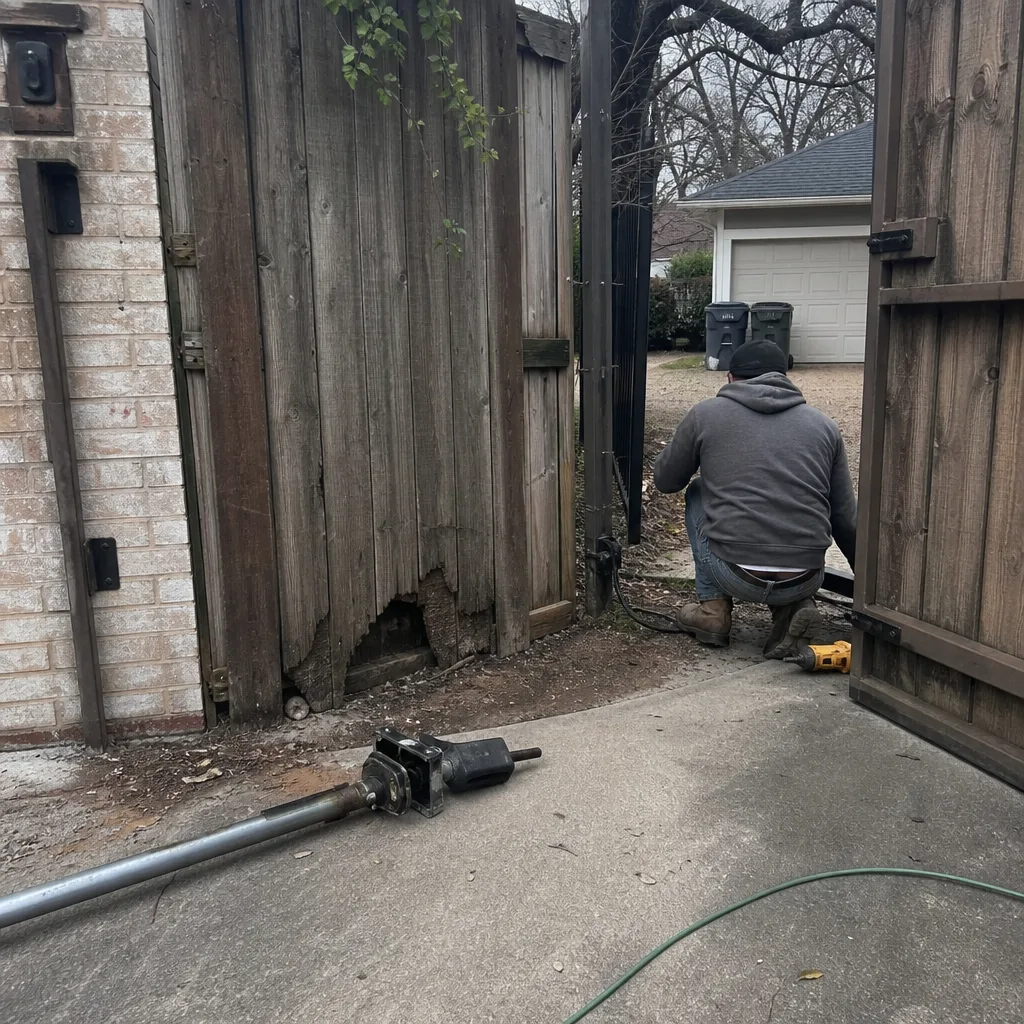 Before
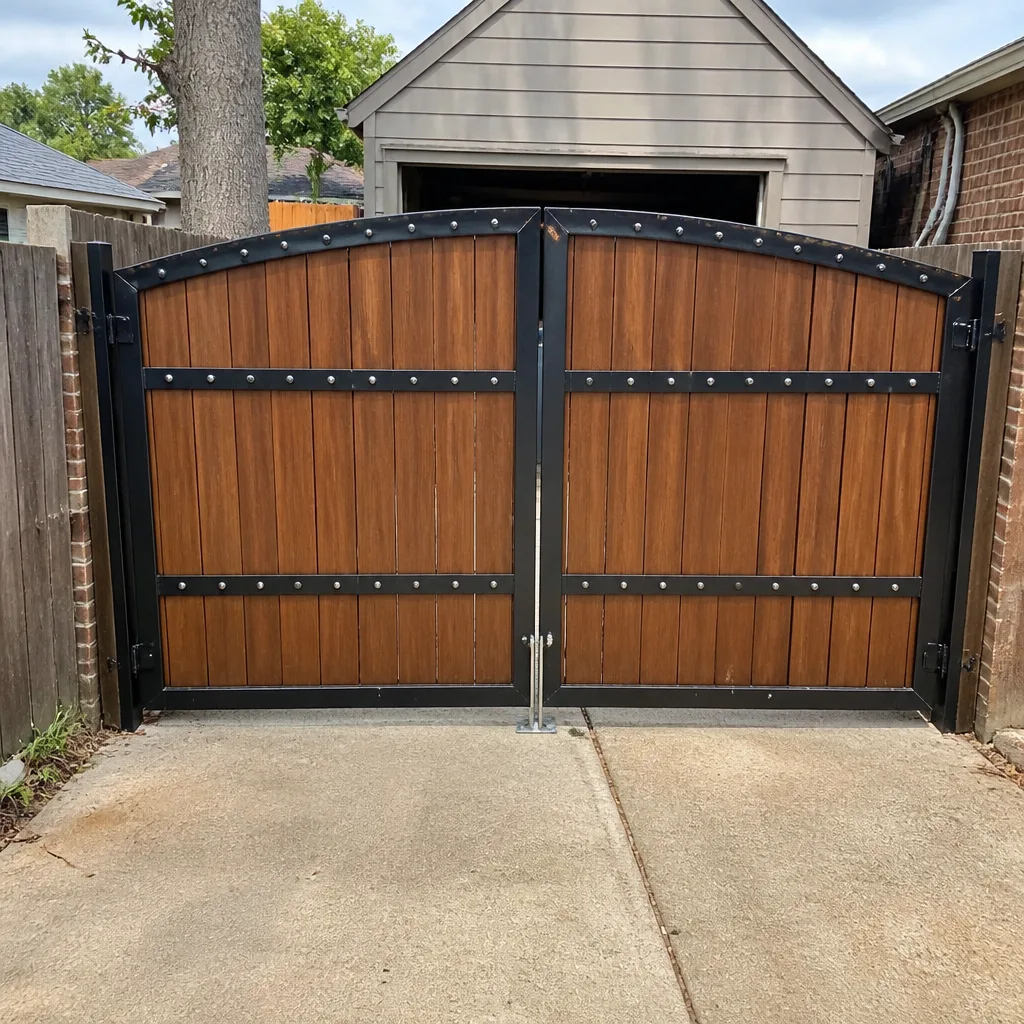 After
After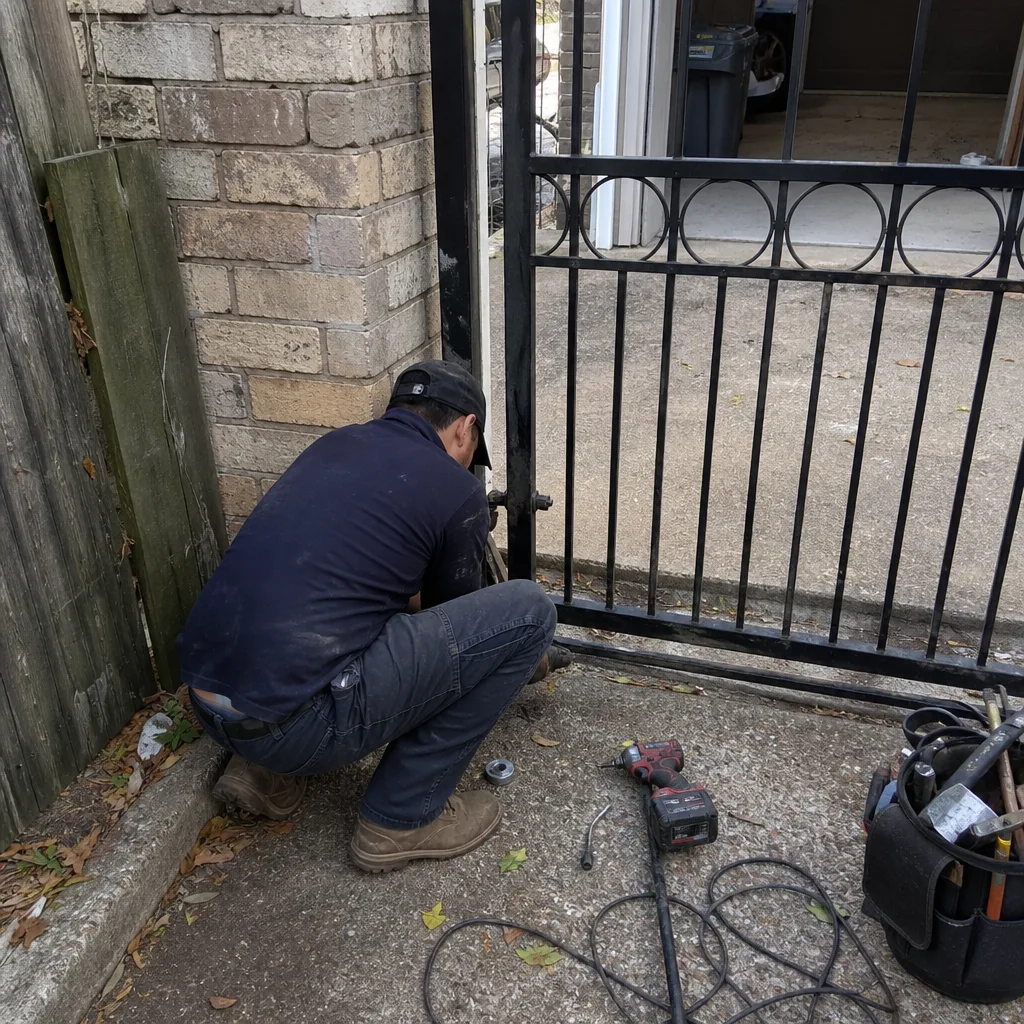 Before
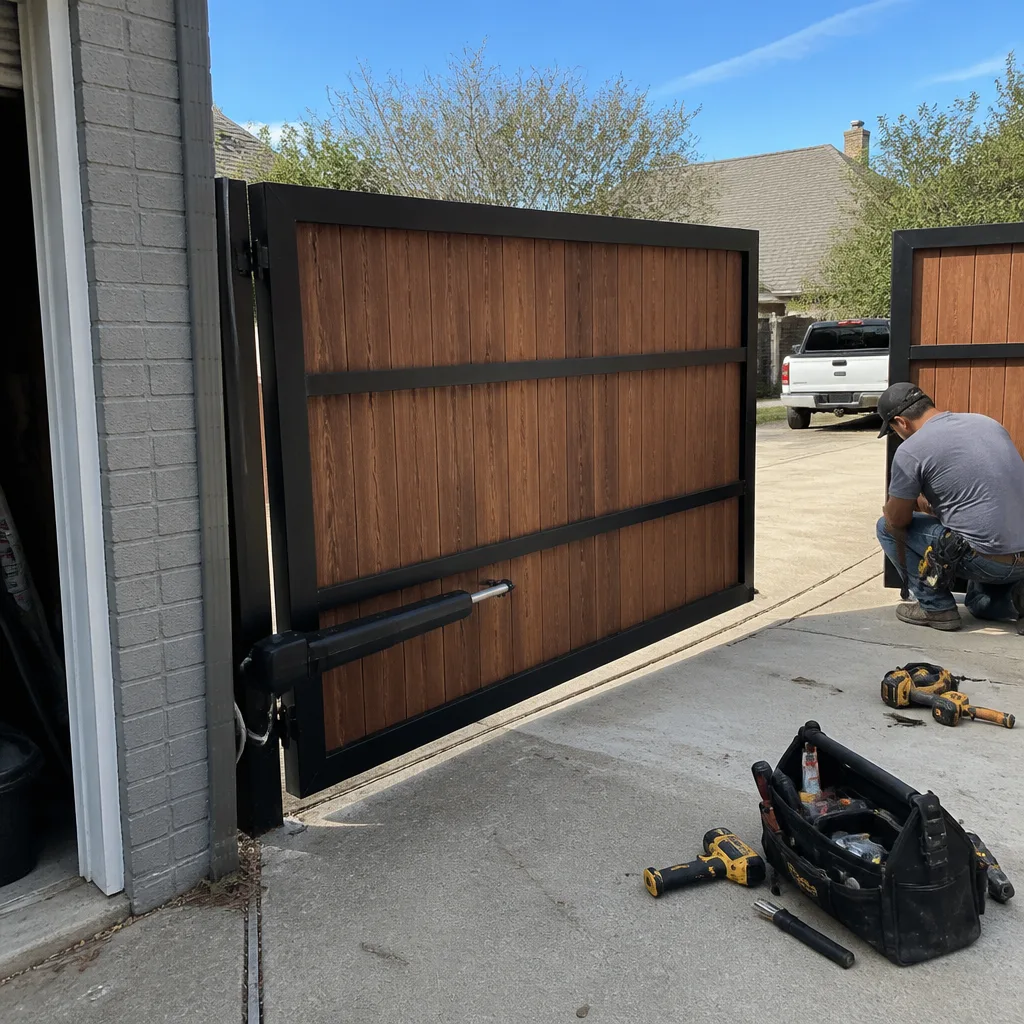 After
AfterGate Repair Permits, Codes & Inspections in TX: What You Need to Know
Most folks assume a gate repair never needs a permit. Most of the time, they’re right. But the exceptions in Texas are specific enough that guessing wrong means pulling out work you already paid for, and that’s a phone call nobody wants to make. The City of Arlington has flagged gate installations during routine fence inspections that homeowners thought were simple repairs, because the trigger wasn’t the gate itself. It was what changed around it. This guide walks through exactly when Arlington and Tarrant County want a permit, when they don’t, and how to avoid paying twice for the same gate. Texas doesn’t license gate contractors at the state level, so that means the responsibility for knowing the local code sits squarely with whoever is holding the welder. If that’s you, keep reading. If it’s a company you’re about to hire, our How to Hire a Gate Repair Contractor in Arlington: A Step-by-Step Guide will tell you what questions to ask before the first cut.
Quick Answer
Most gate repairs in Arlington don’t require a permit: replacing a hinge, a wheel, a motor capacitor, a picket, or welding a cracked weld is maintenance, not construction. A permit does come into play when you’re installing a new gate where none existed, replacing a structural post set in concrete, or adding an automatic opener that requires new electrical work. If the work changes the gate’s footprint, height, or electrical load, assume Arlington wants a look at it first.
Table of Contents
- When a Repair Becomes an Improvement in Arlington
- Structural Components: Posts, Footings, and the Concrete Rule
- Automatic Gate Openers and Electrical Permits in Tarrant County
- HOA Approval vs. City Permit: Two Separate Processes
- Unpermitted Work and Texas Home Sale Disclosure
- What Arlington’s Municipal Code Actually Says
- Step-by-Step: Figuring Out If Your Gate Job Needs a Permit
- Permit Costs, Inspection Timing, and What Inspectors Check
When a Repair Becomes an Improvement in Arlington
Here’s the plain-language version of how Arlington’s code treats gate work. A repair restores the gate to what it was before. You replace a bent hinge, you weld a cracked seam, you swap out a control board. No permit. An improvement changes what the gate is or how it works. You add height to a drive gate, you install a pedestrian gate in a section of fence that never had one, you pour a new footing because the old post heaved out of the ground. That’s where Arlington’s building official starts asking questions, and rightly so.
The threshold isn’t some arbitrary number. It’s physical. If the post comes out of the ground, the footing is disturbed, or the gate’s swing arc changes, Arlington’s Building Inspections Division treats that as new construction, not maintenance. In our experience, this is the single most common surprise for homeowners in Dalworthington Gardens and Pantego. They think they’re fixing a sagging gate. The city sees a new structural element that was never inspected. Both are true, but only one of them matters when the inspector drives by.
Here’s the rule of thumb we give callers in Arlington: if the project needs concrete, a post hole digger, or a trench, check before you dig. If it needs a wrench, a welder, and a level, you’re almost always clear.
Structural Components: Posts, Footings, and the Concrete Rule
A gate sags in the hinge post, not in the middle. That’s the first thing we say to anyone who calls about a dragging drive gate. And it’s exactly where the permit line sits. The post is the structure. The panel that hangs from it is just metal on hinges.
When you replace a gate panel and leave the posts in place, Arlington does not require a permit. You’re swapping a component, not altering the structure. But when the post itself has rotted, cracked, or been pushed out of plumb, and you have to dig out the old concrete and set a new post in a fresh footing, that is a structural change. Arlington wants a permit for that work, and here’s the reason that matters to your wallet: the inspector isn’t just checking the post is straight. They’re checking the footing depth, the concrete coverage, and the setback from the property line.
Specifically, in Arlington’s code, a gate post on a drive gate typically sits in a footing that goes below the frost-influenced soil. North Texas doesn’t have deep frost like Minnesota, but we get enough seasonal movement in the clay-heavy soil east of Cooper Street that a shallow footing will walk the post out of plumb within two winters. We’ve pulled posts in the Dalworthington Gardens area that were set 18 inches deep in heavy clay with no gravel base. They failed exactly the way you’d expect. The fix is the same: dig to code depth, set the post, pour the concrete, and schedule the inspection.
Get this wrong and you’ll be doing it again in two years, except now the gate motor is fighting the post, the track is out of level, and the hinges are binding. Fix the panel without the post and you’ll fix it twice. That’s not a sales line. It’s the sequence of events we see on a repair call every month in this city. For Gate Repair Warning Signs: A Arlington Homeowner’s Reference Guide, see our earlier write-up.
What counts as “structural” on a gate in Arlington:
- Post replacement: any time the post leaves its original footing, it’s structural.
- Footing modification: new concrete, deeper excavation, expanded diameter. Structural.
- Hinge-to-post re-mounting: new bolt pattern in an existing post is maintenance. New post to support the new pattern is structural.
- Track or roller path changes: on slide gates, changing the track bed or perimeter means new construction. Swapping a roller is maintenance.
- Gate panel replacement: not structural, so long as the posts stay put and the swing geometry doesn’t change.
Automatic Gate Openers and Electrical Permits in Tarrant County
Adding an automatic opener to a gate that has always been manual is the second big permit trigger in the Arlington area. The opener itself is a manufactured appliance. The motor, the control board, the remote receiver: none of that needs a city permit. But the electrical feed to the opener often does.
If you’re running a new dedicated circuit from your main panel to the gate, pulling wire through conduit underground, or adding a subpanel at the gate location, that’s electrical work, and Tarrant County wants an electrical permit pulled by a licensed electrician or a properly registered contractor. A new low-voltage run from a transformer to the opener on a system like a Ghost Controls or Mighty Mule swing arm usually doesn’t trigger an electrical permit, but once you’re talking about a 120-volt line to power a heavier Elite or DoorKing slide operator, it absolutely does.
Here’s the part most homeowners never see coming: Arlington’s gate inspections for automatic openers include safety device verification. The inspector wants to confirm the photo eyes or safety edges are present and functional, that the gate reverses on contact, and that the force settings meet the UL 325 standard. UL 325 is the federal safety standard for automatic gate operators, and it applies to every operator installed after 2001, whether it’s a new gate or a retrofit. We service nine major brands in this part of Tarrant County, LiftMaster and FAAC and BFT among them, and the safety edge requirements are nearly identical across all of them. The brand doesn’t matter. The standard does.
If the opener is replacing a failed unit on a gate that already had power and operational safety edges, that’s a repair, not an installation. No electrical permit needed. The grey area is when the old opener was so obsolete that installing the new one requires re-running the power feed. Then you’re not repairing. You’re rewiring. And the county wants to know about it.
HOA Approval vs. City Permit: Two Separate Processes
This is where Arlington gets genuinely confusing, and it’s where we spend a lot of time on the phone. A Homeowners Association approval and a city permit are not the same thing. They don’t come from the same office, they don’t follow the same rules, and one does not satisfy the other.
HOAs govern appearance: gate height, material, color, style, sometimes even the brand of opener you’re allowed to mount on the post. The city governs safety and structure: footing depth, setback, electrical code, UL 325 compliance. You can have an HOA that approves a cedar-and-iron gate with a particular stain color, while the city denies the permit because the proposed post footing doesn’t meet code. You can also have the exact reverse: city approves the work because it’s structurally sound, and the HOA rejects it because the design conflicts with the neighborhood’s architectural guidelines.
If you live in a deed-restricted community, for instance in parts of southwest Arlington or newer developments along the I-20 corridor, you need both sign-offs before the work begins. Neither one waits for the other. We tell homeowners to start with the HOA because their review is typically faster and more design-focused. Then take that approval to the city for the structural permit. The alternative, doing the city first and then finding out the HOA won’t approve the style, means re-engineering the plan and amending the permit. That’s weeks of delay and extra fees no one wants to eat.
And here’s the hard truth: HOA rules can be stricter than city code but never looser. If the HOA demands a gate style that violates Arlington’s code, the city wins. The permit office isn’t going to waive a setback requirement because your neighborhood’s covenants board said they liked the look.
Unpermitted Work and Texas Home Sale Disclosure
The State of Texas requires sellers to disclose known material defects and unpermitted work on the Seller’s Disclosure Notice. The form asks directly: are you aware of any improvements made without a required permit? That’s not a suggestion. That’s a signed statement with legal consequences if you lie on it.
Unpermitted gate work rarely burns you on inspection day. It burns you two, five, or eight years later, when you’re selling the house. A sharp buyer’s inspector notices the new gate post has no inspection record with the city. The buyer’s lender may not care. The buyer will. They’ll ask for the permit history, and if there isn’t one, they’ll either walk or demand a price reduction to cover retroactive permitting, which in Arlington involves an after-the-fact permit at a higher fee, possible re-inspection of work that’s now buried in concrete, and in rare cases partial removal to prove the footing is adequate.
None of this is hypothetical. We’ve been called out by homeowners in the Huntwick area who sold a house and had the closing held up because the buyer’s agent flagged an unpermitted electric gate install from five years prior. The homeowner paid more in retroactive fees and engineer verification than the original permit would have cost by a factor of four. The smart play is simple: if the job is big enough to warrant a permit, the permit is cheap insurance against a problem you’ll otherwise own at the worst possible moment, which is closing day.
What Arlington’s Municipal Code Actually Says
Arlington regulates fences and gates under the city’s Unified Development Code, specifically the chapters dealing with accessory structures. A gate is treated as part of the fence or as an accessory to a drive or walk, depending on the location. Gates attached to fences are fence components. Stand-alone gates across driveways are accessory structures. The distinction matters because accessory structures have their own setback and height rules.
For a typical single-family residential gate in Arlington, the relevant rules look like this:
- Setback: a driveway gate must sit behind the front property line. Arlington is strict about this; a gate that sits in the right-of-way is a code violation whether it’s permitted or not.
- Height: in most single-family zones, a drive gate can’t exceed 8 feet. Gates in front of the house, like a small pedestrian gate, typically cap at 6 feet. There are corner-lot visibility triangles that lower the height limit further on the street side.
- Materials: Arlington’s fire code requires that an automatic gate not block fire department access. If the gate is the primary entry to the property and the fire department can’t open it, the code requires a Knox key switch or other approved emergency override.
- Electrical: any 120-volt feed to a gate opener must be on a GFCI-protected circuit, and underground conduit must be buried to the depth listed in the current adopted NEC edition.
No one expects a homeowner to have these memorized. That’s what the building department is for, and you can find more guides & resources on our site if you want to read further. The desk is staffed by people who genuinely want to help you get it right the first time. If you call and describe the job, they’ll tell you whether it’s a repair or an improvement, and they’ll tell you over the phone without making you fill out twelve forms to get an answer.
Step-by-Step: Figuring Out If Your Gate Job Needs a Permit
Use this as your pre-job checklist. It takes ten minutes and it may save you a few thousand dollars and a headache at the closing table.
- Is a post being replaced or reset? If yes, stop. This is a structural change. Call Arlington Building Inspections or check the city’s online permit portal. Start the permit before the post hole is dug.
- Is new concrete being poured? If yes, same as above. Footings are structural. Concrete means permit.
- Is the gate’s height, width, or location changing? If yes, treat it as new construction. A taller gate on the same posts is still a different gate in the city’s eyes.
- Is a new automatic opener being installed where none existed? If yes, check the power source. New 120-volt line means an electrical permit. Existing outlet or low-voltage transformer only, you’re likely fine without one, but verify with the city because Arlington sometimes requires a simple electrical review for any new operator installation that alters the gate’s force profile.
- Is an old opener being replaced with a similar new one? If yes, and the power and safety edges are existing, it’s a repair. No permit.
- Is the gate within an HOA community? If yes, get the HOA sign-off regardless of the city permit status. They’re separate. Doing both in parallel saves weeks.
- Still not sure? Take photos of the gate from both sides, write down the type of work, and call Arlington Building Inspections. Describe it in plain words. They’d rather you call than guess.
Permit Costs, Inspection Timing, and What Inspectors Check
Arlington’s permit fees for a gate or fence project are modest relative to the cost of the work itself. As of this writing, a simple residential fence or gate permit in Arlington runs in the low three figures, typically under $200 for a straightforward post-and-panel gate replacement. An electrical permit for a new opener feed is a separate line item and varies based on the circuit scope. If you’re having the work done by a contractor like Gatewood Fence & Gate’s team, the permit cost gets passed through at cost. We don’t mark up permit fees. You pay what the city charges, and you see the receipt.
Inspection timing in Arlington is generally fast. For a simple gate post inspection, you can often get a next-day slot. The inspector checks three things on a post replacement: the hole depth before concrete, the concrete coverage around the post after the pour, and the final plumb and setback. On an automatic opener inspection, they check the safety edges, the photo eyes if applicable, the force-test reversal, and the emergency access override if the gate is the primary driveway entry.
We’ve had inspectors in Pantego and Dalworthington Gardens take a tape measure to a footing and compare it to the approved drawing. This is not a rubber stamp. It’s a real check by a person who does this every day, and that’s a good thing. It means the gate that passes inspection is a gate that stays square and safe.
If you’re outside Arlington city limits but still in Tarrant County, the rules shift slightly. Unincorporated Tarrant County is less uniform: some areas enforce county building codes, others defer to the utility easement and road setback requirements only. The safest move for anyone in the county’s unincorporated pockets is to call the Tarrant County Permits office and ask the same question you’d ask in Arlington: is this a repair or an improvement? The clerk will know. That’s their job.
Common Mistakes to Avoid
- Assuming the gate company knows the permit rules. Some do. Some don’t. A company that works across five counties may quote you a one-size-fits-all answer that doesn’t match Arlington’s code. Get the permit answer in writing before you sign anything.
- Skipping the HOA because the city said it’s a repair. The HOA doesn’t care what the city called it. If they want design review, they want design review. Two processes, two approvals.
- Replacing a post without checking setbacks. Arlington’s setback for gates is measured from the property line, and a post that was technically out of compliance before may get flagged during a re-inspection for the new work. You’re not grandfathered into an illegal setback just because the old gate sat there for 20 years.
- Using a 120-volt opener on a circuit that’s not GFCI protected. The inspector will catch it. Outdoor 120-volt receptacles and circuits in Arlington are required to be GFCI protected. It’s a one-hour fix if caught before inspection, and a call-back if caught after.
- Not keeping the permit paperwork after the job. You’ll need it when you sell. Scan it. File it. The buyer’s title company will ask for it years from now, and you won’t remember where the folder went.
- Treating an opener change as “just swapping a motor.” On a gate motor and opener service, the electrical work defines the permit always adding the word permit question. Don’t assume.
- Believing a handyman’s word over the city’s. The handyman may be great with a welder. He does not speak for the permitting authority. One phone call settles it.
When to Call a Professional
If any of the following sound like your situation, this is where you stop Googling and start calling: your post has moved and the gate drags on the ground, you’re adding an opener to a gate that’s always been manual, your HOA sent you a letter about the gate style, or you’re selling the house and can’t find the paperwork from the last gate install. These are moments where guessing costs real money. We’ve been doing gate repair and gate installation in Arlington since 2001, and we’ve seen every version of this story play out. Gatewood Fence & Gate offers free estimates in Arlington and the surrounding communities. Call (817) 241-4067 and we’ll tell you plainly whether you need a permit, what it’ll cost, and whether you need us at all.
Frequently Asked Questions
Most gate repairs in Arlington don’t need a permit. Replacing hinges, wheels, pickets, panels, or control boards counts as maintenance. You only need a permit when the work changes the structure, for example replacing a post set in concrete or moving the gate’s location. Call (817) 241-4067 if you’re not sure which category your job falls into.
A basic residential gate or fence permit in Arlington typically costs under $200, with electrical permits for new opener circuits added separately based on scope. The exact number depends on the job, and the city can quote it over the phone before you commit. Our estimates are free if you’d rather have us walk you through it.
For gate repair in Arlington that’s an active safety or security problem, a sagging gate blocking a driveway or a gate that won’t stay closed, we do everything we can to get there the same day. Call (817) 241-4067 and a real person answers. If we can’t get to it today, we’ll tell you that up front and put you on the board for the first slot tomorrow.
Then you don’t have a legal gate. In Arlington, HOA approval and city permits are separate, and the city’s building code wins when they conflict. You’ll need to adjust the plan to satisfy the city, then resubmit to the HOA with the revision. It’s an extra step, but skipping it is worse.
Not if you’re swapping a failed opener for a similar unit on existing wiring. It does if the new opener needs a new 120-volt feed, a subpanel, or new underground conduit. Low-voltage transformer systems on brands like Ghost Controls or Mighty Mule usually stay on the no-permit side, but it’s worth a quick call to verify before the electrician starts trenching.
You’ll likely have to disclose it on the Texas Seller’s Disclosure Notice, and a buyer’s discovery can delay closing while you chase a retroactive permit at a higher fee. In Arlington, after-the-fact permits cost more and trigger a review of work that may already be under concrete. Getting the permit originally is always cheaper and faster than fixing the problem at sale time.
The Bottom Line
Most gate repairs in Arlington are permit-free, and that’s because most repairs don’t touch the structure. When a post comes out of the ground, when the gate’s location or height changes, or when a new opener needs real electrical work, the city wants to know. HOA approval sits on top of that, not alongside it. And the unpermitted work you skip today becomes the disclosure problem you own at closing. When in doubt, call Arlington Building Inspections, or call us at (817) 241-4067 and we’ll help you figure it out. The name is on the shop, and the shop is down the road. That’s the oldest accountability there is.
Written by Hal Gatewood, Owner at Gatewood Fence & Gate, serving Arlington since 2001.